How to Study with the Pomodoro Technique: A Study Plan That Actually Works
Use the Pomodoro Technique to study smarter: plan revision in sessions, combine it with active recall and spaced repetition, and follow a sample study day.
On this page
- Why Pomodoro works so well for studying
- Step 1: Turn subjects into session-sized tasks
- Step 2: Fill each session with active study
- Step 3: Use your breaks wisely
- Step 4: Plan the day in cycles
- Step 5: Adjust the timer to the subject
- Step 6: Review your week
- Common study mistakes with Pomodoro
- Questions people ask
Key takeaways
- Turn each subject into small, concrete session-sized tasks before you start.
- Fill your pomodoros with active study (self-testing, practice problems, explaining) rather than rereading.
- Use short breaks to move and rest, and space subjects across days to remember more.
- Track sessions per subject so you can see, honestly, where your study time goes.
The Pomodoro Technique is one of the most popular study methods in the world, and for good reason. Revision days are long, motivation is fragile, and your phone is always within reach. Breaking study into 25-minute sessions makes it easier to start, easier to keep going and easier to measure.
But a timer alone doesn't make you learn. This guide shows how to combine Pomodoro with the study methods that research says actually work, with a sample day you can copy.
Why Pomodoro works so well for studying
- Starting is easier. “Revise organic chemistry” is daunting. “25 minutes on reaction mechanisms” is doable.
- Breaks are built in. Regular breaks help you stay alert across a long day instead of fading after lunch.
- It shows the truth. Counting sessions shows how much focused study you really did, which is often less than the hours you spent “studying”.
- It protects you from your phone. A 25-minute promise is easier to keep than “I won't check it all afternoon”.
New to the method? Start with the complete Pomodoro Technique guide.
Step 1: Turn subjects into session-sized tasks
The biggest mistake is starting a timer with a vague goal. Before you begin, break each subject into tasks you could finish in one to three sessions:
| Vague | Session-sized |
|---|---|
| Study biology | Make flashcards for cell respiration (1 session) |
| Revise maths | Do 8 past-paper integration questions (2 sessions) |
| Work on history essay | Outline the essay and find 3 sources (1 session) |
| Read for English | Read chapter 5 and write a 5-line summary (1 session) |
Estimate how many sessions each task needs. Over a few weeks you'll get surprisingly good at it, which makes planning exam revision much easier.
Step 2: Fill each session with active study
What you do inside the pomodoro matters far more than the timer. Decades of learning research point to a few methods that consistently beat rereading and highlighting:
Retrieval practice (self-testing)
Close the book and try to recall what you know: answer questions, use flashcards, write everything you remember about a topic on a blank page. In a well-known 2006 study, Henry Roediger and Jeffrey Karpicke found that students who practised recalling material remembered much more a week later than students who spent the same time rereading it. Recall feels harder, and that difficulty is what makes it stick.
Spaced repetition
Review topics several times with gaps in between rather than cramming them once. The spacing effect is one of the most reliable findings in memory research. In practice: revisit each topic a day later, a few days later and a week later.
Practice problems and past papers
For maths, science and anything with exams, doing questions under realistic conditions is the closest you can get to the real thing. A 50-minute session is perfect for a section of a past paper.
Explain it simply
Try to explain a concept in plain words, as if teaching a friend. Gaps in your understanding show up immediately.
Interleaving
Mix different types of problems in one session (for example, several kinds of equations) instead of doing twenty of the same type. It feels harder but builds better judgement about which method to use.
Step 3: Use your breaks wisely
When the timer rings, stop and step away. Stand, stretch, drink water, look out of a window. Don't open social media: it fills your head with new input and rarely ends after five minutes. Here are 25 break ideas that recharge you.
A useful trick: just before the break, write one line about what you'll do next. You'll restart in seconds.
Step 4: Plan the day in cycles
Group four pomodoros into a cycle, then take a long break. Switching subjects between cycles keeps things fresh and naturally spaces your revision.
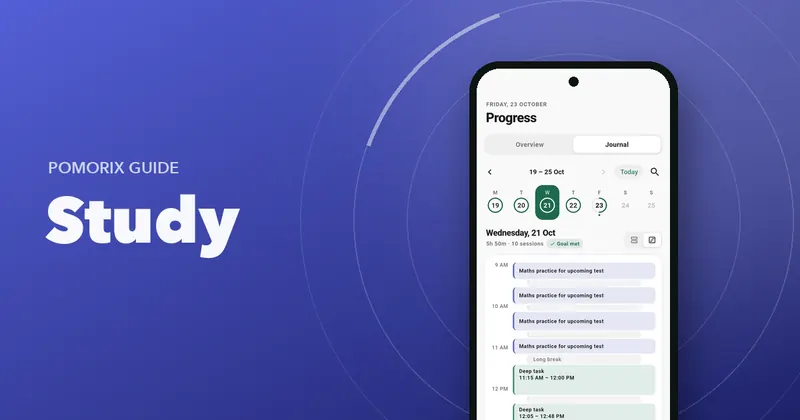
Sample revision day (10 pomodoros)
| Time | Session | Task |
|---|---|---|
| 9:00 | Pomodoro 1 | Self-test on yesterday's biology flashcards |
| 9:30 | Pomodoro 2 | New topic: read and summarise photosynthesis |
| 10:00 | Pomodoro 3 | Make flashcards for photosynthesis |
| 10:30 | Pomodoro 4 | Practice questions on photosynthesis |
| 11:00 | Long break | Walk outside, snack |
| 11:30 | Pomodoros 5–7 | Maths past paper, section B |
| 13:00 | Lunch | Proper meal, away from desk |
| 14:00 | Pomodoros 8–9 | History essay plan and first section |
| 15:00 | Pomodoro 10 | Quick recall: write everything you learned today |
Ten pomodoros is about four hours of focused study. That's a strong revision day. If you want to plan weeks rather than days, read how to make an exam study schedule you'll actually follow.
Step 5: Adjust the timer to the subject
- 25/5 for memorisation, flashcards, reading and subjects you're avoiding.
- 45–50/10 for maths, problem sets, essays and coding assignments that need a long warm-up.
- Shorter (15/3) when you're exhausted, anxious or really can't get started.
Not sure how long you can go? Here's how long you should study without a break.
Step 6: Review your week
Every Sunday, take five minutes to look at your study data:
- How many sessions did each subject get? Is that balanced with your exams?
- Which days and hours were your best?
- How often were you distracted, and by what?
Then plan next week based on what you see, not on how you felt. More on this in how to track your study hours.
Common study mistakes with Pomodoro
- Rereading notes for a whole session. It feels productive but builds little memory. Test yourself instead.
- Phone on the desk. Even a silent phone in view pulls at your attention. Put it in another room, or use Do Not Disturb.
- Skipping breaks during exam panic. You'll burn out by mid-afternoon. Breaks are part of the plan.
- Planning 16 sessions a day. You'll hit 7 and feel like a failure. Plan for 8 to 10 and finish.
Struggling to stay focused even inside the session? Read 15 practical tips to stay focused while studying.
Questions people ask
Is the Pomodoro Technique good for studying?
Yes. It breaks long study days into manageable sessions, makes it easier to start revising, and builds in regular breaks that help you stay fresh. It works best combined with active study methods like self-testing and practice problems.
How long should a study Pomodoro be?
Start with 25 minutes of study and a 5-minute break. For subjects that need long stretches of thinking, like maths problem sets or essay writing, 45 to 50-minute sessions with 10-minute breaks often work better once you're used to focusing.
How many Pomodoros should I study per day?
On a school or college day, 3 to 6 pomodoros alongside classes is realistic. On a full revision day, 8 to 12 (about 3.5 to 5 hours of focused study) is a strong, sustainable target.
What should I do in a study Pomodoro?
One concrete task: answer ten past-paper questions, make flashcards for one chapter, write one essay section, or test yourself on yesterday's notes. Avoid vague goals like 'study chemistry'.