How to Stop Procrastinating: 12 Tactics That Start With Just 25 Minutes
Why you procrastinate (it's not laziness), and 12 tactics to start the tasks you've been avoiding, from tiny first steps to timed focus sessions.
On this page
Key takeaways
- Procrastination is mostly about avoiding uncomfortable feelings, not about laziness or poor time management.
- Make the start tiny and specific: one concrete step, one short timed session.
- Plan when and where you'll start, remove friction, and add friction to distractions.
- Forgive yourself for past delays. Self-criticism tends to make the next delay more likely.
You know the task matters. You have the time. And yet here you are, reading an article about procrastination instead of doing it. (We'll keep this one useful, then send you back to work.)
Procrastination isn't laziness and it isn't a time management problem. Once you see what's really going on, the fixes become much simpler, and most of them start with a single short timer.
Why we procrastinate
Researchers like Tim Pychyl and Fuschia Sirois describe procrastination as a problem of emotion regulation. A task makes us feel something unpleasant (bored, anxious, confused, afraid of doing it badly) and avoiding it makes that feeling go away. Instantly. The relief is real, which is why we keep doing it.
Tasks we tend to avoid are often:
- Vague: “work on the dissertation”. Where do you even start?
- Big: a whole exam syllabus feels like a mountain.
- Boring: forms, admin, repetitive revision.
- Threatening: anything where you might fail or be judged.
So the goal isn't to find more willpower. It's to make starting feel less uncomfortable.
12 tactics that work
1. Shrink the first step until it's almost silly
Not “write the essay”. Not even “write the introduction”. Try “open the document and write one sentence about the main argument”. A step that small feels harmless, and once you've taken it, the next one is easier.
2. Commit to 25 minutes, not to finishing
“I'll work on this until the timer rings, then I can stop” is a deal almost anyone will take. That's the core of the Pomodoro Technique. Most of the time, you won't want to stop when it rings.
3. Still too hard? Try 10 minutes
On really bad days, even 25 minutes feels like a lot. Set 10. The aim is to break the avoidance loop, not to be impressive.
4. Decide when and where, in advance
Psychologist Peter Gollwitzer's research on implementation intentions shows that “if-then” plans (“When I sit down after lunch, I'll open the slides and start the timer”) make follow-through much more likely than vague intentions. Write tomorrow's first session down tonight.
5. Write down what's bothering you about the task
Spend two minutes naming the feeling: “I don't know how to structure this”, “I'm worried it won't be good enough”. Often the real blocker becomes obvious, and so does the next step (ask someone, look at an example, write a rough draft first).
6. Make it a rough draft
Perfectionism is one of the biggest drivers of procrastination. Give yourself permission to do a bad first version. Editing something is far easier than creating something perfect from nothing.
7. Remove friction from the task
Have the file open, the book on the desk, the first problem marked before you stop for the day. The fewer steps between you and starting, the better.
8. Add friction to distractions
Put your phone in another room, log out of social media, use Do Not Disturb. If the distraction takes 30 seconds to reach instead of one, you'll reach for it much less. See how to stop checking your phone.
9. Pair it with something pleasant
Researcher Katy Milkman calls this temptation bundling: only allowing yourself something you enjoy while doing something you avoid. Your favourite tea only during admin sessions. A cosy café only for essay writing. A focus sound you love only while revising.
10. Make progress visible
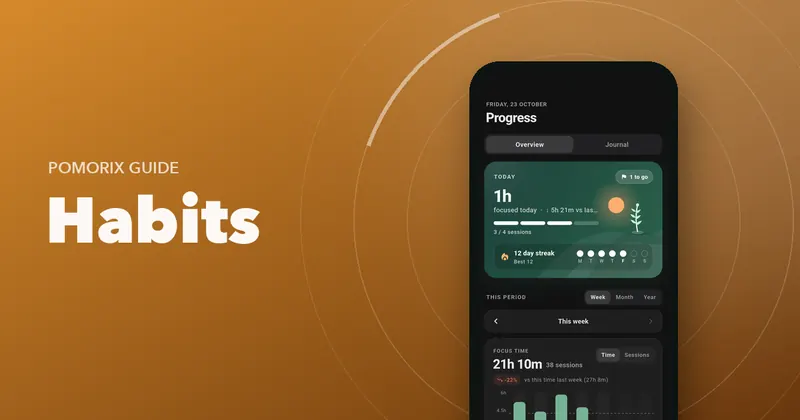
Ticking off a session, watching a daily goal fill up, seeing a streak grow: small visible wins make the next session easier to start. Progress is motivating, especially on long projects where the finish line is weeks away.
11. Work alongside someone
Studying with a friend, in a library or on a video call where everyone works silently makes starting easier. The quiet presence of others is a gentle form of accountability.
12. Forgive yourself
This one sounds soft, but it's backed by research. In a 2010 study by Michael Wohl, Tim Pychyl and Shannon Bennett, students who forgave themselves for procrastinating before one exam procrastinated less before the next. Beating yourself up adds more bad feelings to the task, which makes avoiding it even more tempting.
A 5-minute anti-procrastination routine
- Minute 1: write the task and the smallest first step.
- Minute 2: name what's uncomfortable about it.
- Minute 3: put your phone away and close unrelated tabs.
- Minute 4: open everything you need for the first step.
- Minute 5: start a 25-minute timer and begin.
When procrastination is a bigger problem
If you constantly struggle to start and finish tasks across many areas of life, and it's causing real problems, it's worth talking to a doctor or counsellor. Anxiety, depression and ADHD can all show up as chronic procrastination, and they're treatable. Our article on timers and ADHD has practical tips too.
For everyone else: you don't need to fix procrastination forever. You only need to start the next 25 minutes. Then build the habit, one day at a time, with goals and streaks.
Questions people ask
Why do I procrastinate even when I want to do the task?
Because procrastination is usually about short-term mood, not long-term wants. If a task feels boring, confusing or threatening, avoiding it makes you feel better right now, even though it costs you later. Reducing that initial discomfort is the key.
What is the fastest way to stop procrastinating?
Pick the smallest possible first step, write it down, and set a timer for 25 minutes (or even 10). Commit only to working until the timer rings. Starting is the hardest part, and a short, defined session makes starting much easier.
Does the Pomodoro Technique help with procrastination?
Yes, it's one of its main strengths. 'Work on it for 25 minutes' is far less intimidating than 'finish it', and once you start, momentum often carries you into the next session.
Is procrastination a sign of ADHD?
Procrastination is very common and doesn't on its own indicate ADHD. But if difficulty starting and finishing tasks is severe, long-standing and affects many areas of life, it's worth talking to a doctor.