How to Stay Focused While Studying: 15 Practical Tips That Work
15 practical, research-backed ways to concentrate while studying: set up your space, beat phone distractions, use focus sessions and keep your energy up.
On this page
Key takeaways
- Focus is mostly set up before you start: a clear task, a quiet space and your phone out of reach.
- Work in timed sessions with planned breaks rather than open-ended hours.
- Notice distractions without fighting them: write them down and come back.
- Sleep, movement, water and food are focus tools, not extras.
You open your notes with the best intentions. Five minutes later you're checking a message, then a video, then wondering what's for dinner. Losing focus while studying isn't a character flaw. Your environment, your phone and the way you structure your time all pull against you.
The good news: focus is mostly a set-up problem, and set-up problems can be fixed. Here are 15 practical tips, grouped into before, during and around your study sessions.
Before you start
1. Decide exactly what you'll do
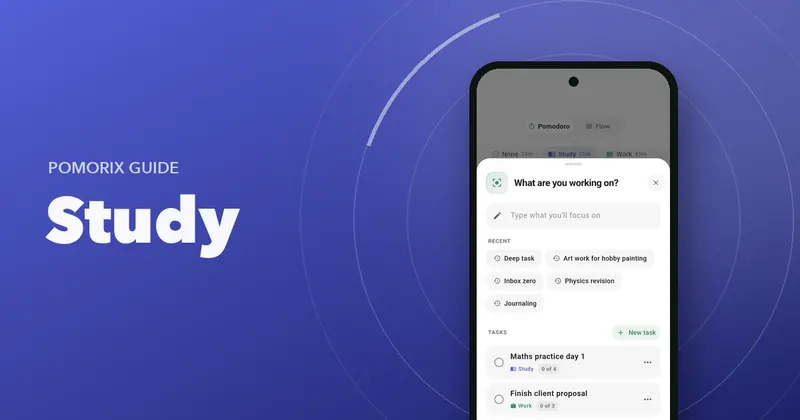
“Study physics” invites wandering. “Do questions 1 to 8 on circular motion” gives your brain a clear target. Write the specific task before you begin. If a task feels too big to start, break it down until the first step is obvious.
2. Put your phone out of reach
Not face down on the desk: out of reach, ideally in another room. A 2017 study by Adrian Ward and colleagues suggested that even a silent phone on the desk can reduce available attention, and while later studies have produced mixed results, almost everyone who tries it notices the difference. If you need your phone for a timer, turn on Do Not Disturb and leave only the timer open. More in how to stop checking your phone.
3. Clear your space
Keep only what you need for this session on your desk. Close browser tabs and apps unrelated to the task. Every visible distraction is a small, constant invitation.
4. Get everything ready first
Water, snacks, charger, books, pens. Each “I'll just quickly grab…” is an exit from focus that often doesn't come back.
5. Pick a consistent study spot
Studying in the same place at similar times helps your brain associate that spot with focus. If your bed is where you watch videos, it's a poor place to revise.
During your study session
6. Use a timer and study in sessions
Open-ended study (“I'll study all afternoon”) is hard to start and easy to drift through. A timed session, such as 25 minutes with the Pomodoro Technique, creates a clear start, a finish line and a built-in break. See how to study with the Pomodoro Technique.
7. Write distractions down instead of acting on them
When you remember something you need to do or want to look up, write it on a “later” list and return to the task. Your brain lets go of the thought once it's safely recorded.
8. Count how often you get distracted
Simply noticing your distractions makes them less frequent. Make a tally mark each time your mind wanders or you reach for your phone. Over a week, watching that number fall is surprisingly motivating.
9. Study actively
Passive rereading is where minds wander most. Active methods keep you engaged: test yourself, answer questions, explain a concept out loud, draw a diagram from memory. Focus and learning improve together.
10. Use steady background sound, if it helps
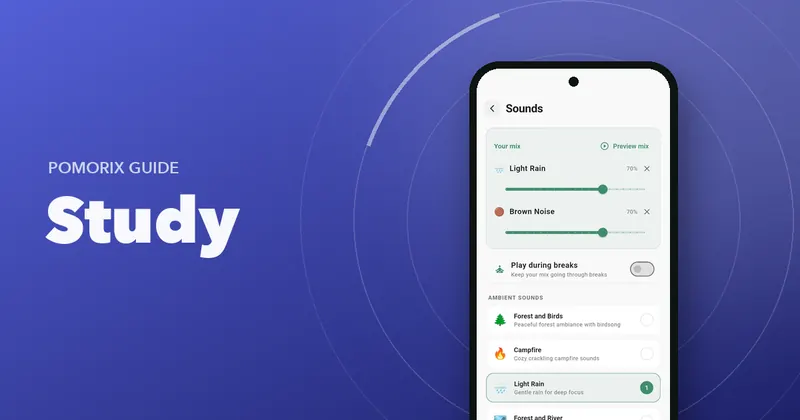
Music with lyrics competes with reading and writing for the language parts of your brain. If silence feels too empty or your surroundings are noisy, try steady sounds like rain, brown noise or soft café chatter. Read choosing focus sounds for studying.
11. Keep the screen awake if you're using your phone as a timer
If the screen turns off, you'll unlock your phone to check the time, and that's how a quick check becomes 10 minutes elsewhere. A timer that stays visible prevents it.
Around your sessions
12. Take real breaks
Stand up, move and rest your eyes between sessions. Skip social media on breaks: it keeps your attention busy and rarely ends on time. Here are 25 break ideas.
13. Study hard things at your best time
Most people have a window when thinking feels easier, often mid-morning, though it varies. Track your sessions for a couple of weeks and you'll see your own pattern. Put your hardest subject there.
14. Sleep, move, eat, drink
Poor sleep hurts attention and memory more than almost anything else. Regular movement, water and proper meals make focus noticeably easier. These aren't separate from studying; they're part of it.
15. Set a daily goal and track progress
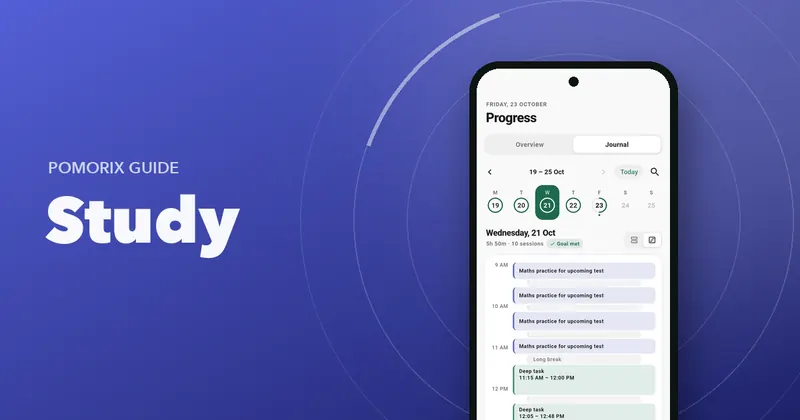
A goal like “5 focus sessions today” turns studying into something you can complete. Seeing your progress, and a streak of days in a row, gives you a reason to start the next session even when motivation is low. See how to build a daily focus habit.
A quick focus checklist
| Before | During | After |
|---|---|---|
| Specific task written down | Timer running | Real break, away from screens |
| Phone out of reach, DND on | Distractions go on the “later” list | Next step noted |
| Desk and tabs cleared | Active study methods | Session logged |
| Water and materials ready | Steady sound if needed | Daily goal checked |
If nothing seems to work
If you've fixed your setup and still struggle to concentrate for even short periods, consider talking to a doctor or school counsellor. Sleep problems, stress, anxiety and conditions like ADHD can all affect focus, and support can make a real difference. Our article on using timers with ADHD has practical ideas too.
Questions people ask
Why can't I focus when I study?
Common causes are a vague task, a phone within reach, a noisy or cluttered space, studying for too long without breaks, and not enough sleep. Fixing the setup (clear task, phone away, timed sessions) usually helps more than willpower.
How can I focus on studying for long hours?
Don't try to focus for long hours in one go. Study in 25 to 50-minute sessions with short breaks, take a longer break every couple of hours, and keep your total to what you can sustain, usually 3 to 5 hours of focused study a day.
Does music help you focus while studying?
It depends on the person and the task. Music with lyrics tends to interfere with reading and writing. Instrumental music, lo-fi or steady background sounds like rain or brown noise are less distracting for many people.
How do I stop getting distracted by my phone while studying?
Put it in another room or out of sight, turn on Do Not Disturb, and only check it on breaks. Making the phone harder to reach works far better than trying to resist it while it sits on your desk.