How Many Pomodoros a Day Is Realistic? A Guide to Setting a Daily Focus Goal
How many Pomodoro sessions you can really do in a day as a student or professional, how to set a daily focus goal, and how to grow it without burning out.
On this page
Key takeaways
- Most people can do 6 to 10 genuinely focused 25-minute pomodoros a day; 12 or more is a very strong day.
- Deep, demanding work has a lower ceiling than routine work: 3 to 4 hours of real focus is a lot.
- Set a goal you can hit on an ordinary day, not your best day, and raise it slowly.
- Track sessions or minutes and keep a streak: consistency beats occasional heroics.
Once you get into the Pomodoro rhythm, a natural question appears: how many should I be doing? Ten? Sixteen? Should a “productive” day be eight hours of back-to-back pomodoros?
Short answer: fewer than you think. Here's what's realistic, why, and how to set a daily goal that grows with you instead of burning you out.
The realistic numbers
One classic pomodoro is 25 minutes of focus. Four of them with breaks take about two hours. Here's what different daily counts mean in practice:
| Pomodoros (25 min) | Focused time | What it feels like |
|---|---|---|
| 2–4 | 50 min – 1 h 40 | A good start, or a solid day alongside classes and meetings |
| 5–7 | 2 – 3 hours | A productive, sustainable day for most people |
| 8–10 | 3 h 20 – 4 h 10 | A strong day of focused work |
| 11–14 | 4.5 – 6 hours | Exceptional: exam season or a crunch, not every day |
| 15+ | 6+ hours | Rarely sustainable; quality usually drops |
If those numbers look small, remember that this is focused time: single task, no checking, no drifting. A typical “eight-hour” workday contains far less of it. Cal Newport, author of Deep Work, suggests that around four hours of truly deep work a day is near the limit for most people, and many experts in demanding fields practise or write for roughly that long.
Why more isn't always better
- Mental fatigue is real. The quality of your thinking in pomodoro 14 is not the same as in pomodoro 3.
- Life happens. A goal that needs a perfect day will fail most days, and missing goals is demotivating.
- Recovery matters. Sleep, exercise and downtime are what make tomorrow's focus possible.
The goal isn't the biggest number in one day; it's a good number on most days. Twenty days of six pomodoros (about 50 hours) beats three heroic 14-pomodoro days followed by a week of burnout.
How to set your daily goal
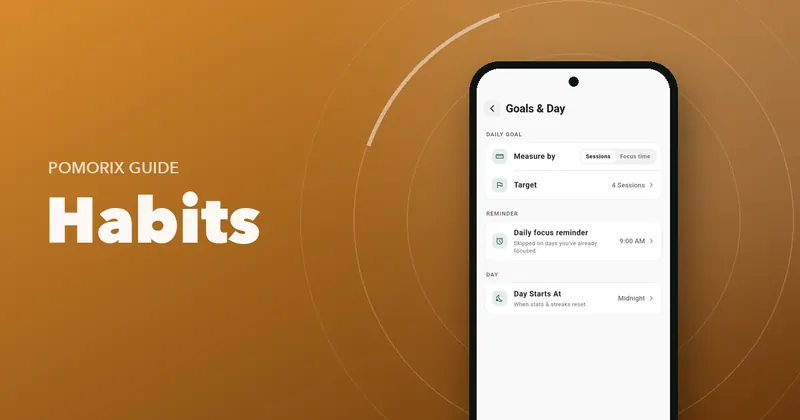
- Measure first. Use a Pomodoro timer for a week without a goal and note how many you really finish on an ordinary day.
- Set the goal at your ordinary day, not your best. If you averaged 5, set 5.
- Raise it slowly. When you hit it on most days for two weeks, add one session.
- Have a minimum for bad days. “At least one pomodoro” keeps a streak alive when life gets busy.
Sessions or minutes?
Count sessions if you mostly use one length. “Five pomodoros” is easy to picture and satisfying to tick off.
Count minutes if you mix 25-minute and 50-minute sessions, or use a count-up Flow timer. A goal like “2 hours of focus” treats every minute equally, whichever way you split it.
Suggested goals by situation
| Situation | Starting goal | Stretch goal |
|---|---|---|
| Student on class days | 3–4 sessions | 6 sessions |
| Exam revision days | 6–8 sessions | 10–12 sessions |
| Full-time job with meetings | 4 sessions | 6–8 sessions |
| Freelancer or remote worker | 6 sessions | 8–10 sessions |
| Side project after work | 1–2 sessions | 3 sessions |
Plan your pomodoros around your energy
Not all hours are equal. Most people have one or two peak windows when hard thinking feels easier, often in the morning, but night owls are real too. Put your most demanding sessions there and save admin for low-energy times.
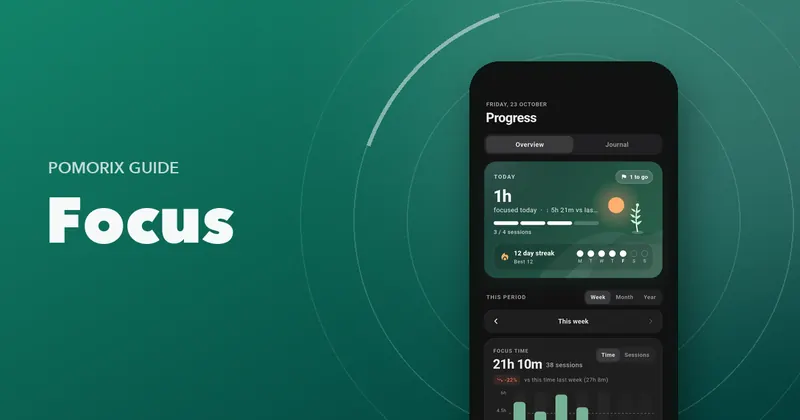
The best way to find your peak hours is to look at your own data. After a few weeks of tracking, patterns become obvious.
Use streaks, but kindly
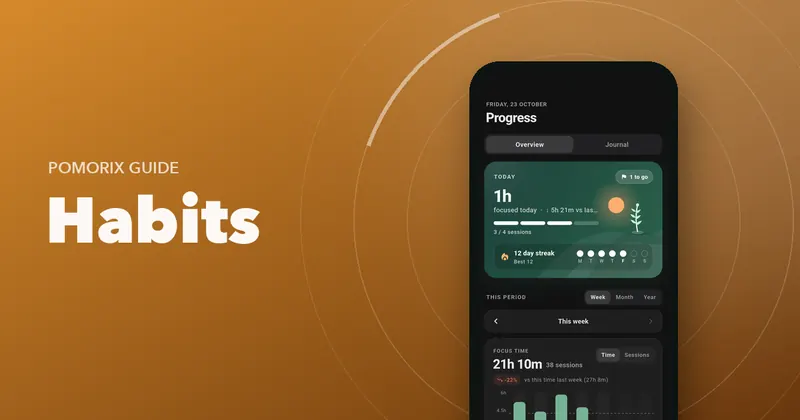
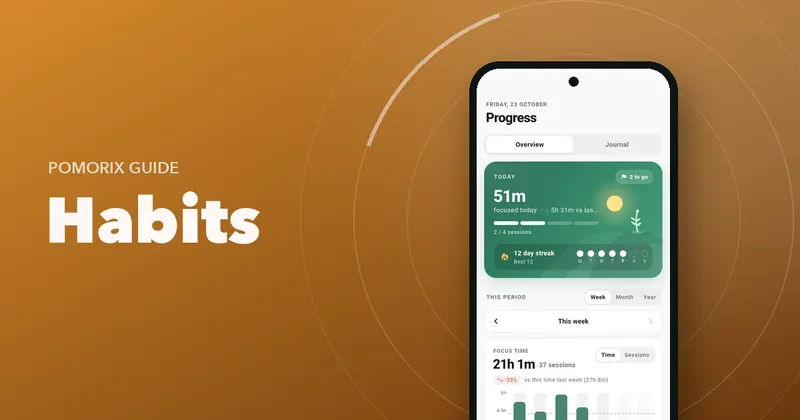
A day streak (consecutive days where you hit your goal, or at least did one session) is a powerful motivator. Seeing “12 days” makes you want to protect it. Two tips:
- Keep the bar for the streak low enough to survive busy days.
- If you break it, restart the next day. One missed day doesn't erase the habit. Research on habit formation suggests missing a single day has little effect on building a habit over time.
More on this in how to build a daily focus habit with goals and streaks.
The bottom line
For most people, 6 to 10 pomodoros on a good day is excellent, and 4 is a perfectly respectable start. Pick a goal you can hit on an ordinary day, track it honestly, and let it grow. If you want to see where all that focus goes, read how to track your study hours.
Questions people ask
How many Pomodoros should I do per day?
Start with 4 to 6 (about 2 to 2.5 hours of focused work). Once you hit that comfortably most days, increase to 8. Many people find 8 to 10 is their sustainable ceiling for focused work.
Is 8 hours of Pomodoro possible?
Eight hours of genuine, deep focus is beyond what almost anyone can sustain. Eight hours of mixed work including meetings, admin and lighter tasks is normal, but the truly focused part is usually 3 to 5 hours.
How many Pomodoros should a student do for exam revision?
On full revision days, 8 to 12 pomodoros (about 3.5 to 5 hours of focused study) is a strong and sustainable target. On school or college days, 3 to 6 alongside classes is realistic.
Should my daily goal be in sessions or minutes?
Sessions are simple and motivating if your session length is fixed. Minutes are better if you mix lengths or use a count-up Flow timer, because every minute counts regardless of how it was split.